
The problem with “rehearsing” in industry
Suppose you are the HSE manager at a gas transport company. One of your compressor stations has a fire scenario in its emergency procedure. Your operators know what they are supposed to do. They have read the procedure, completed the e-learning, earned the green tick.
But have they ever done it? Have they ever isolated a gas leak under pressure, with the alarm going and a colleague asking for coordination?
Almost never. And that is the structural problem of safety training in industry: the situations that most require training are precisely the situations you cannot rehearse live. Explosion risk. Toxic release. Emergency shutdown under production pressure. Power failure at high voltage.
For that gap, most organisations have one answer: a classroom, an instructor, a scenario on paper. And that works, right up until it counts.
What makes VR different from other formats
The difference between VR and every other training format does not sit in the technology. It sits in what people do versus what they hear or read.
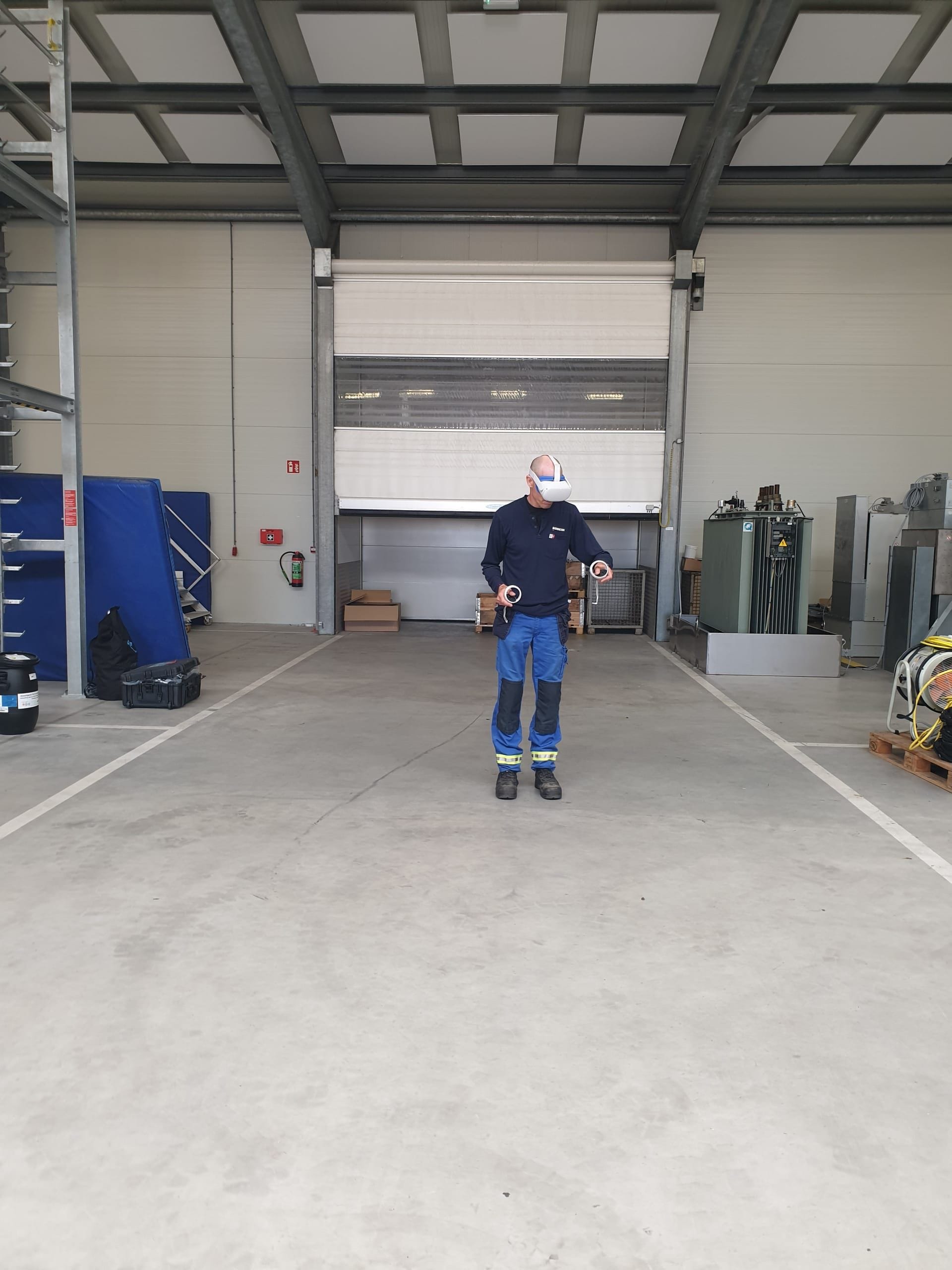
In a VR simulation an operator stands in the middle of a situation. The alarm goes. The gauge climbs. A colleague asks for instruction. The valve is on the other side of the room. The operator has to decide, not think about what the procedure says, but act.
That moment of decision is what anchors the rehearsal. Research in cognitive psychology is clear about it: people remember actions they performed themselves significantly better than actions they saw or read about. That holds more strongly still when emotional activation is involved: tension, time pressure, consequences.
“Our operators now stand in the VR environment inside the same installation they will be on shift in tomorrow. For the first time we can genuinely rehearse what happens when it goes wrong, without it going wrong.”
VR creates that emotional activation. Not at the level of a real emergency, but enough to put the brain in a different mode than reading a PDF does.
When VR works, and when it does not
VR is not a universal answer. There are situations where it is evidently the right choice, and situations where it is not.
VR works best for:
- Rare but critical situations (fire, explosion, failure, emergency shutdown)
- Operations where mistakes cannot be undone
- Environments that are dangerous or logistically inaccessible for training
- Situations where time pressure, stress or communication are part of the competence
- New installations that are not operational yet
VR is less suitable for:
- Knowledge transfer that works fine through e-learning or microlearning
- Procedures where the physical action itself (force, motor skill) is central
- Situations that occur daily and are already routine
The most effective use of VR is as part of a blended approach: e-learning for the knowledge base, VR for the scenario rehearsal, practice or coaching for the refinement.
The installation question: generic or specific?
This is where a lot of VR training fails. Generic VR simulations exist for firefighting, ATEX procedures, working at height. They are cheaper and available faster than bespoke work.
The problem: an operator working at compressor station Ommen does not recognise the generic VR compressor station. The panels are in the wrong place. The escape route runs differently. The valves are not the same ones. They learn the procedure, but not their procedure, in their installation.
Transfer, the extent to which what you learn in training also gets applied for real, depends directly on how closely the training environment approaches the real one. A generic simulation gives low transfer. An installation-specific simulation gives high transfer.
That is why at STARK we always build on the client’s real installation. P&ID schematics, as-built drawings, photographs of the site: that is the basis. The operator recognises their workplace. And that is what makes the difference.
Conclusion
VR training is not a gadget. It is the only format that makes rehearsal possible for situations you cannot train live, and it does so in a way that sticks.
But the technology is not the success factor. The success factor is specificity: a simulation standing as close as possible to the real installation, the real procedures and the real decisions somebody has to take.
Generic VR gives generic results. Installation-specific VR gives behavioural change that holds when it counts.
VR is one format within a broader offering, and rarely the first one you start with. Which format suits which learning objective is in the guide on setting up or renewing a corporate academy. The specificity it turns on begins with the installation itself, see VR and XR simulations. The compressor station this piece opens with comes from energy and gas.