
The wrong first question
“We want to do something with VR.” That is how a fair share of conversations open, and it is understandable: somebody saw a demo at a trade fair and it made an impression.
The problem is the order. The format is a means, and which means fits depends entirely on what has to change on the work floor. Start with the format and you go looking afterwards for a problem to match it. There usually is one, but it is rarely the most important thing you could have tackled.
Start with the behaviour
There is one question that largely makes the choice: what will somebody do differently, and why are they not doing it now?
Only a few answers are possible, and each points a different way.
They do not know. Knowledge is missing. That is the cheapest problem to solve and almost always a matter of explanation: e-learning, video, a good instruction.
They knew but have forgotten. The knowledge was there and has drained away. That does not call for new training but for repetition, spread over time.
They know, but act differently under pressure. This is the hardest case and the most expensive to ignore. Explanation does not help here. There has to be rehearsal in conditions resembling the real ones.
They know, but cannot reach it at the moment itself. Then training is not the answer; support during the work is. An instruction on the tablet, a QR code on the machine.
The formats side by side
E-learning is the workhorse: suited to knowledge transfer, quick to make, easy to record, scales well across languages and sites. It is the default you deviate from when there is a reason, not the other way round.
Microlearning is not separate content but a different rhythm: short units spread over weeks. Strong for holding knowledge after a training and for people who never have an uninterrupted hour. Weak as a first introduction to a complex subject, because the coherence is lost.
Video and animation come into their own for things you have to see: a process happening inside a pipe, an operation whose sequence is hard to capture in text. Expensive to change, so suited to whatever is stable.
3D work instructions sit between documentation and training. They are not there to learn from but to work from, at the moment itself, at the machine.
Serious games pay off when the behaviour is stubborn and repetition is needed: deciding under time pressure, working together during an incident.
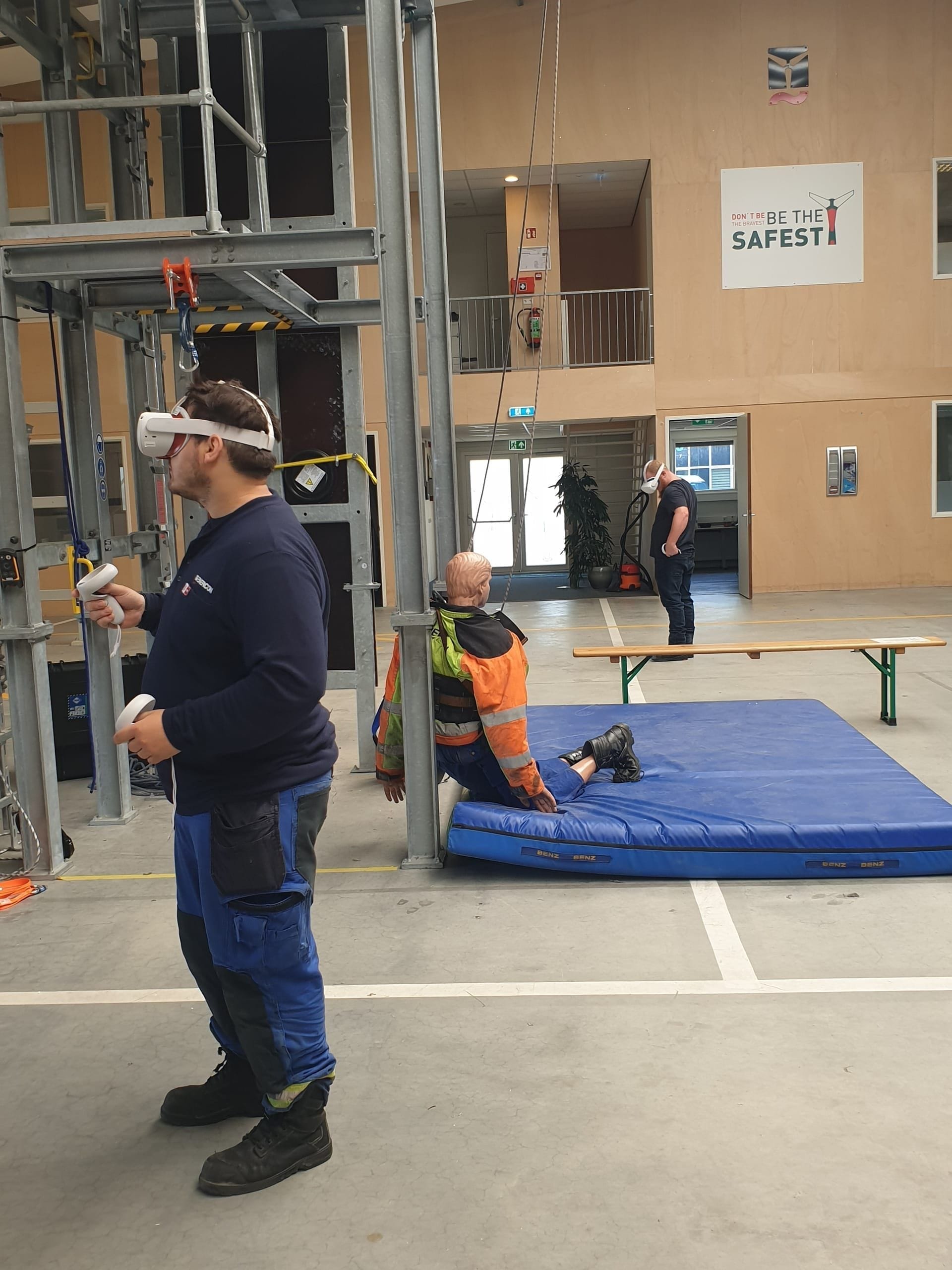
VR is the heaviest and most expensive format, and precisely for that reason the narrowest. It earns its keep on situations you cannot rehearse in reality because they are too dangerous, too expensive or too rare. For anything you can also rehearse on an installation, VR is a detour.
Combining is usually the answer
In practice the question is rarely which format, but in which order.
An operator who has to be ready for an emergency scenario first works through a short e-learning covering the procedure, then rehearses the scenario, and over the following months gets microlearning that keeps the knowledge alive. Three formats, one programme, each in the place where it delivers most.
The rule of thumb that follows: pick the cheapest format that can change the behaviour, and only step up to a more expensive one when you can explain why the cheaper one would not manage it. Anyone answering that honestly ends up more often at a well-made e-learning than at a headset, and that is not a disappointment. That is budget left over for the next problem.
That order is easier to settle once the structure underneath is already there. How to build one is in the guide on setting up or renewing a corporate academy. The Training Format Scan walks the trade-off through with you, and the technology overview puts the formats side by side.